

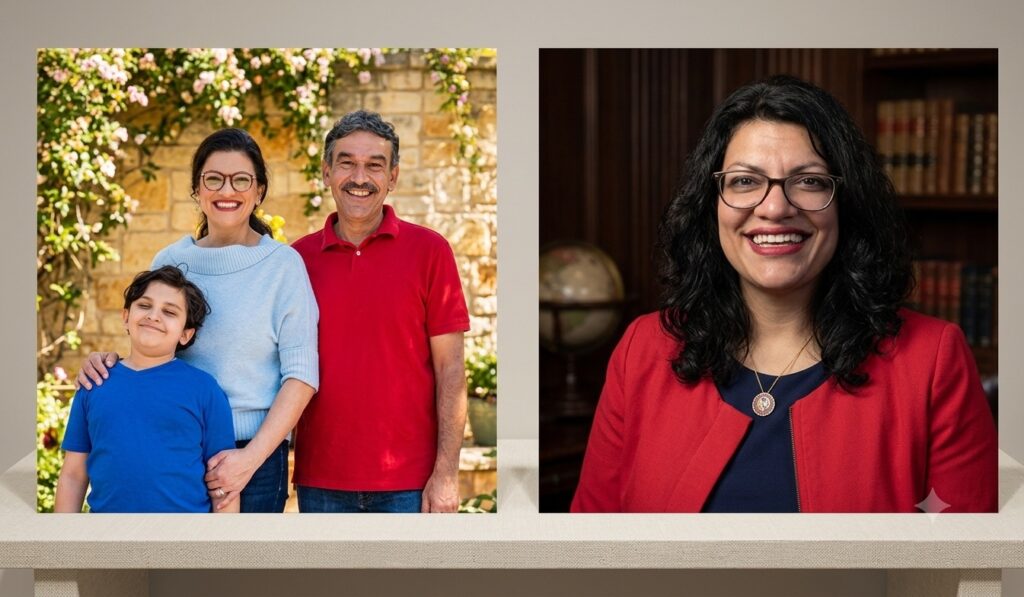
Not every compelling story belongs to someone standing at a podium. Some of the most powerful narratives unfold quietly — in family homes, immigrant neighborhoods, and lives lived with deliberate dignity. Fayez Tlaib is one such story. Born in Palestine and later building his life in Michigan, he became widely recognized as the former husband of U.S. Congresswoman Rashida Tlaib. Yet his journey goes deeper than that single association. Rooted in Fayez Tlaib’s Palestinian heritage and shaped by years of immigration, family devotion, and quiet resilience, his biography reflects something universal — the courage it takes to build a meaningful life away from the spotlight.
Quick Bio: Fayez Tlaib
| Detail | Information |
|---|---|
| Full Name | Fayez Tlaib |
| Date of Birth | July 1, 1976 |
| Birthplace | Beit Ur al-Fauqa, West Bank, Palestine |
| Nationality | Palestinian-American |
| Current Residence | Dearborn, Michigan, USA |
| Ex-Wife | Rashida Tlaib (U.S. Congresswoman) |
| Children | Two sons — Adam (b. 2005) and Yousif (b. 2011) |
| Marriage Year | 1998 |
| Divorce Year | 2015 |
| Profession | Private (not publicly disclosed) |
Early Life and Family Background
Fayez Tlaib’s story begins in a small hillside village in the West Bank. He was born in Beit Ur al-Fauqa, a tight-knit Palestinian community located northwest of Jerusalem, where generations of families have lived surrounded by shared traditions, Islamic values, and deep community bonds. Growing up there meant absorbing a culture that prizes collective strength, family loyalty, and cultural pride above almost everything else.
The village itself carries layers of history. Its residents are connected not just geographically but through long-standing family networks, where neighbors are often also relatives, and where cultural memory passes from one generation to the next through daily life rather than formal instruction. Fayez grew up within that framework. His formative years were shaped by community-centered values — the kind that don’t leave a person even when geography changes.
What makes his background especially interesting is the connection it shares with Rashida Tlaib’s family. Rashida’s mother was also born in Beit Ur al-Fauqa, meaning the two families share roots in the same Palestinian village. That shared origin created a cultural thread between them long before their paths converged in the United States. You could say their eventual meeting was, in many ways, a reunion of shared heritage — two people from the same small world finding each other in a much larger one.
His Palestinian upbringing didn’t just give him cultural roots. It gave him a framework for understanding resilience, patience, and the importance of protecting one’s family. Those values would follow him across an ocean and anchor his life in ways that are still visible today.
How Old Is Fayez Tlaib?
Fayez Tlaib was born on July 1, 1976, which makes him 49 years old as of mid-2025. He and Rashida Tlaib were born the same year — she on July 24, 1976 — making them almost exactly the same age, just 23 days apart. When they married in 1998, both were 22 years old, beginning their adult lives together just as Rashida was finishing her undergraduate degree at Wayne State University.
His age places him squarely in a generation of Palestinian-Americans who immigrated to the United States during the late 1980s and 1990s, a period when Dearborn, Michigan was rapidly becoming one of the most significant Arab-American communities in the entire country. He arrived in a city that was actively shaping a new identity — Arab by heritage, American by citizenship — and he became part of that story.
By the time Rashida entered Congress in 2019, Fayez was 43 years old and had been living a private post-divorce life for four years. He has watched his sons grow into teenagers and now young men, and he has done so quietly, far from the cameras that follow his ex-wife.
Cultural Roots and Identity
Palestinian identity is not a simple thing to carry. It comes with history, pride, grief, and a fierce sense of belonging to a place many have never been able to return to freely. Fayez Tlaib carries that identity with him every day, and it shapes the way he navigates community life in Dearborn.
Dearborn is no ordinary American city. It’s home to one of the largest Arab-American populations in the United States — roughly 30% of its residents identify as Arab-American. For Fayez, settling there meant never fully leaving behind the cultural rhythms of his upbringing. Arabic is spoken in the streets. Mosques anchor neighborhood life. Palestinian and Lebanese restaurants sit alongside American diners. The city functions, in many ways, as a cultural bridge — and for immigrants like Fayez, that bridge made the transition far less jarring.
His identity as a Palestinian-American is layered. On one side, there’s the heritage — the village, the family name, the Islamic traditions passed down through generations. On the other, there’s the American experience — raising children in Michigan schools, participating in community events, and building a life within a pluralistic democracy. Navigating both simultaneously requires a particular kind of self-awareness, and everything known about Fayez suggests he’s done it with quiet confidence.
Cultural values rooted in Palestinian heritage — family honor, community duty, parental commitment — seem to define his choices more than any professional ambition or public persona. That’s not a limitation. For many people, it’s the highest form of intentional living.
Meeting Rashida Tlaib and Marriage
How Their Paths Crossed
Fayez Tlaib met Rashida Harbi — now known publicly as Rashida Tlaib — in the late 1990s, during a period when both were active in Michigan’s Arab-American community. Their shared Palestinian heritage served as common ground from the very beginning. They weren’t strangers stumbling into an unlikely connection. They were two people from the same cultural world, shaped by the same village roots, finding each other in a new country.
Rashida was a student at Wayne State University, pursuing a degree in political science that would eventually lead her to law school and then to political office. Fayez, having immigrated from Palestine before 1998, was building his new life in Dearborn. Their connection grew naturally — rooted in shared faith, mutual cultural values, and a commitment to community that both of them had carried from their Palestinian upbringing.
They married in 1998, when both were 22 years old. It was a union grounded in tradition — a marriage that reflected the values of their heritage while beginning a shared chapter in America. At the time, Rashida was not yet the political figure she would become. She was a young woman starting her adult life, and Fayez was the partner who walked into that beginning alongside her.
Their marriage lasted 17 years. During that time, Rashida earned her law degree, began her political career, and rose through Michigan state politics. Fayez remained largely in the background — a supportive presence at community events and family gatherings, consistently stepping back so that Rashida’s trajectory could unfold. It wasn’t passivity. It was partnership.
Who Is Rashida Tlaib?
Understanding Fayez Tlaib’s story requires understanding the woman he was married to for nearly two decades. Rashida Tlaib is one of the most recognized political figures in modern American progressive politics. Born on July 24, 1976, in Detroit, she is the eldest of 14 children born to working-class Palestinian immigrant parents. Her mother hails from Beit Ur al-Fauqa — the same village where Fayez was born.
She graduated from Wayne State University with a degree in political science in 1998 — the same year she and Fayez married — and later earned her Juris Doctor from Thomas M. Cooley Law School in 2004. Her political career began in earnest when she interned with Michigan State Representative Steve Tobocman in 2004 and was elected to the Michigan House of Representatives in 2008.
In 2018, Rashida Tlaib made history. She became the first Palestinian-American woman elected to the United States Congress, serving Michigan’s 13th congressional district. She is also one of the first two Muslim women elected to Congress, alongside Ilhan Omar. Known as a member of “The Squad” — a group of progressive congresswomen — she has been a fierce advocate for working-class communities, civil rights, and Palestinian rights on the world stage.
Her national profile grew rapidly during her congressional tenure. She’s been a central figure in debates over U.S. foreign policy, particularly regarding Israel and Palestine. She has faced censure, controversy, and considerable public scrutiny — all of which occurred after her divorce from Fayez in 2015. Through all of it, Fayez remained absent from the public record, choosing silence over statement.
Family Life and Children
The most enduring part of Fayez Tlaib’s story is his role as a father. He and Rashida have two sons: Adam, born in 2005, and Yousif, born in 2011. Raising children while one parent’s career takes national center stage is never simple. Yet by all accounts, Fayez approached that responsibility with the same quiet seriousness that defines everything else about him.
During the marriage, he managed much of the domestic stability that allowed Rashida to pursue her political ambitions. Community, school life, family routines — these things don’t manage themselves, especially when one parent is increasingly consumed by public duties. Fayez’s role in holding that structure together may not have made headlines, but it mattered.
After the 2015 divorce, Rashida referred to herself publicly as a single mother during her 2018 congressional campaign. That framing speaks to the distribution of parenting responsibilities, but it doesn’t erase Fayez’s continued presence in his sons’ lives. He remains in Dearborn, close to his children, and sources consistently describe their co-parenting relationship as cordial and focused on what’s best for Adam and Yousif.
Their sons are growing up in a uniquely complex family environment — the children of a now-famous congresswoman, raised in a city with deep Arab-American identity, with a father who models privacy and a mother who models public service. Both are valid paths, and the fact that both parents have maintained dignity and respect through their separation gives their sons a rare example of what mature co-parenting looks like.
Fayez Tlaib’s Work and Professional Life
Here’s where the public record runs thin — and that thinning is itself a telling detail. Fayez Tlaib has never disclosed his professional life publicly. No verified career information exists in mainstream media or public records. Some unverified reports suggest involvement in local business or the construction industry in Michigan, but none of those claims have been confirmed by credible sources.
What’s clear is this: he supported a family in Dearborn for 17 years. He contributed to raising two children. He maintained a household through the period when Rashida’s career was escalating from local community work to state legislature to national Congress. None of that happens without some form of stable income and professional engagement. The details simply aren’t public — and Fayez hasn’t offered them.
That choice tells you something important about the man. In an era where everyone seems to compete for visibility, Fayez has built an invisible professional life by design. He doesn’t appear on LinkedIn. He doesn’t give interviews. He doesn’t have a public social media presence. His career exists entirely outside the media ecosystem, and he seems to prefer it that way.
His approach challenges the assumption that professional identity must be public to be valid. Plenty of meaningful work happens without a press release. And for someone who grew up in a culture that values family above individual ambition, the absence of a public career narrative might say less about what he hasn’t achieved — and more about what he’s chosen to prioritize.
Fayez Tlaib’s Link to Politics
Fayez Tlaib has no political career of his own. He’s never run for office, never served in a public role, and never made public statements about policy or partisan issues. His link to politics is entirely relational — he was married to Rashida Tlaib during the formative years of her political rise, and that proximity placed him, reluctantly, in the orbit of public interest.
During Rashida’s time in the Michigan state legislature and throughout her 2018 congressional campaign, Fayez occasionally appeared at community functions and family-related events. He wasn’t a political partner in the strategic sense. He was a husband and father who happened to be standing near one of the country’s fastest-rising political figures.
His indirect exposure to Michigan politics and national political life is worth noting because it creates pressure that most people never experience. When your former spouse becomes a member of Congress and a national media figure, your private life becomes the subject of public curiosity — whether you invited that scrutiny or not. Fayez handled it by doing almost nothing at all. No statements, no counter-narratives, no social media activity. Just silence and continued private life.
That political adjacency also means his sons are growing up in a household where political events are never abstract. Their mother’s work — congressional votes, protests, international controversies — filters into family life. Fayez’s grounding role, keeping home life stable and culture-centered, likely provides his sons with a necessary counterweight to the noise of their mother’s public world.
Read More: Isis Rae Boykin: Biography, Age, Parents, Family & Interesting Facts
Private Life and Personality
If there’s a single defining characteristic that emerges from every public account of Fayez Tlaib, it’s this: he values privacy above almost everything else. No verified interview with him exists anywhere in mainstream media. He has no confirmed social media accounts. His personal reflections, opinions, and daily life are entirely his own — shared with no audience beyond those he trusts personally.
That’s not avoidance. That’s a deliberate philosophy. In a world where proximity to fame creates enormous pressure to perform and overshare, Fayez has resisted that pressure consistently and completely. He is, as one profile put it, a media ghost — connected to one of the most recognizable political names in Michigan, yet invisible in every public record.
What little is known about his personal interests suggests a preference for outdoor activities, including cycling. His daily life in Dearborn revolves around family and community — the same anchors that have defined his identity since childhood. He hasn’t pursued a new public relationship or professional venture that’s attracted any attention, and he hasn’t sought any.
His personality, as filtered through the lens of what’s publicly known, suggests someone grounded, patient, and self-aware enough to know that public visibility wasn’t what he wanted — even when it was what circumstances placed near him. That kind of self-knowledge is genuinely rare.
Rumors and Challenges
Being connected to a high-profile politician invites speculation, and Fayez Tlaib has been the subject of his share. Various online sources have published unverified claims about his net worth (ranging from $50,000 to several million dollars, none with credible sourcing), his professional background, and his personal life after divorce. None of those claims has been confirmed.
The divorce itself generated curiosity. After 17 years of marriage, Fayez and Rashida separated in 2015. Neither party ever publicly disclosed the reasons. By the time Rashida’s 2018 campaign was underway, a spokesperson described her as a single mother — a description that prompted further speculation about the nature of their separation. The truth is simpler and less dramatic: the specific reasons for their divorce remain private, and both parties have respected that boundary.
Fayez’s decision not to respond publicly to rumors is consistent with his broader approach to privacy. Feeding speculation with counter-narratives only extends the news cycle. Silence, in his case, functions as a form of dignity. He’s never complained publicly, never sought sympathy, and never attempted to shape his own narrative in the media. The result is that his actual story — rooted in immigration, family, and cultural identity — often gets lost beneath the noise of unverified speculation.
The absence of drama should be taken for what it is: evidence of a person who genuinely doesn’t want to be part of the drama.
Fayez Tlaib’s Life Today
As of 2025, Fayez Tlaib continues to live in Dearborn, Michigan — the same city where he built his life after immigrating from Palestine. He remains involved in raising Adam and Yousif, who are now teenagers growing into young men. His co-parenting relationship with Rashida is described consistently as respectful and cooperative, with both parents focused on their sons’ wellbeing above any personal differences.
His daily life is private by design. No new public relationships. No confirmed professional ventures. No social media footprint. He occupies the Dearborn community as an ordinary resident — connected to its Arab-American culture, presumably involved in local mosque and community life, and largely invisible to the national media apparatus that surrounds his ex-wife.
That invisibility shouldn’t be mistaken for inactivity. He’s raising two sons. He’s maintaining a life rooted in cultural identity in one of America’s most distinctive Arab-American communities. He’s modeling something specific for his children: that a meaningful, dignified life doesn’t require a public audience.
What his life looks like today is, in many ways, exactly what he seems to have always wanted — quiet, family-centered, rooted in place and culture, and entirely his own.
Cultural Values and Legacy
Fayez Tlaib’s story is inseparable from the broader Palestinian-American experience in Michigan. He is one of thousands of Palestinians who immigrated to the Detroit-Dearborn area seeking stability, opportunity, and the chance to raise a family in a community that understands their heritage. His choices — from the community he settled in to the values he’s modeled for his sons — reflect that collective experience in deeply personal ways.
The value system he carries is one rooted in family as the primary unit of meaning. Palestinian culture, like many Arab and Islamic traditions, places enormous weight on parental responsibility, community belonging, and the protection of family honor. Fayez has embodied those values throughout his adult life — first as a husband and partner, then as a father and co-parent, and now as a private individual who refuses to let public curiosity override personal integrity.
His legacy, to the extent that the word applies to a private man, lives in his children. Adam and Yousif carry his name, his heritage, and whatever values he’s quietly passed to them over the years of their upbringing. They grow up knowing that one of their parents chose fame and public service, and the other chose family and quiet dignity. Both are legitimate expressions of a life well-lived.
Life Lessons and Reflections
There are things Fayez Tlaib’s life teaches without him ever saying a word publicly. The first is that not every meaningful contribution is visible. His years of domestic stability and quiet support gave Rashida Tlaib the foundation she needed to become the political figure she is. That contribution won’t appear in a Wikipedia article about him, but it shaped history in its own way.
The second lesson is about identity and rootedness. Fayez moved from Palestine to America and never tried to erase where he came from. He settled in a community that reflected his heritage, raised his sons with those values intact, and built a life that bridged two worlds without abandoning either. That kind of cultural continuity in an immigrant context is something many people find genuinely difficult to achieve.
The third, and perhaps most striking, lesson is about the power of privacy as a form of integrity. In a media environment that rewards oversharing and punishes silence with speculation, Fayez Tlaib chose silence anyway. He declined to become a character in someone else’s public narrative. He insisted on defining himself — or, more accurately, on not defining himself publicly at all. That choice reflects a kind of confidence most people don’t have.
His story is a reminder that the quietest lives can carry the heaviest meaning.
Conclusion
Fayez Tlaib’s biography is, at its core, a story about choosing depth over visibility. Born in a small Palestinian village, he immigrated to Michigan, married a woman who would become one of the country’s most recognizable congresswomen, raised two sons with care and steadiness, and then stepped quietly into a private life when the marriage ended. He’s never sought an audience for any of it.
What he leaves behind is not a career timeline or a media legacy. It’s a demonstration that a life can be full, rooted, dignified, and meaningful without a single camera ever pointing your way. In an age obsessed with public identity, that’s a genuinely countercultural thing to model.
Fayez Tlaib’s life matters not because of who he was married to, but because of who he chose to be — consistently, privately, and on his own terms.
FAQs About Fayez Tlaib
Who is Fayez Tlaib?
Fayez Tlaib is a Palestinian-American man best known as the former husband of U.S. Congresswoman Rashida Tlaib. He was born on July 1, 1976, in Beit Ur al-Fauqa, in the West Bank, and later immigrated to Dearborn, Michigan, where he continues to live today.
When did Fayez Tlaib marry Rashida Tlaib?
Fayez and Rashida married in 1998, when both were 22 years old. Their marriage lasted approximately 17 years before they divorced in 2015.
How many children does Fayez Tlaib have?
Fayez has two sons with Rashida Tlaib: Adam, born in 2005, and Yousif, born in 2011. Both sons continue to be central to his life in Dearborn, Michigan.
Why did Fayez Tlaib and Rashida Tlaib divorce?
The specific reasons for their 2015 divorce have never been publicly disclosed by either party. Both have maintained dignified silence on the matter and focused instead on co-parenting their sons.
What does Fayez Tlaib do for a living?
Fayez Tlaib’s professional life is not publicly documented. No verified information exists about his career, income, or business activities. He has deliberately kept that aspect of his life entirely private.
Where does Fayez Tlaib live now?
As of 2025, Fayez Tlaib lives in Dearborn, Michigan — the same Arab-American community where he built his life after immigrating from Palestine.
Does Fayez Tlaib have social media?
No confirmed or verified social media accounts exist for Fayez Tlaib. He maintains no known public digital presence, which is consistent with his broader commitment to privacy.
What is Fayez Tlaib’s net worth?
Fayez Tlaib’s net worth is not publicly known or verified. Various online sources have speculated on figures, but none have provided credible sourcing to support any specific number.
